01 / Prepare and convert
Accepted waste and biomass are prepared for the project. Steam thermolysis produces product gas and a solid residue.

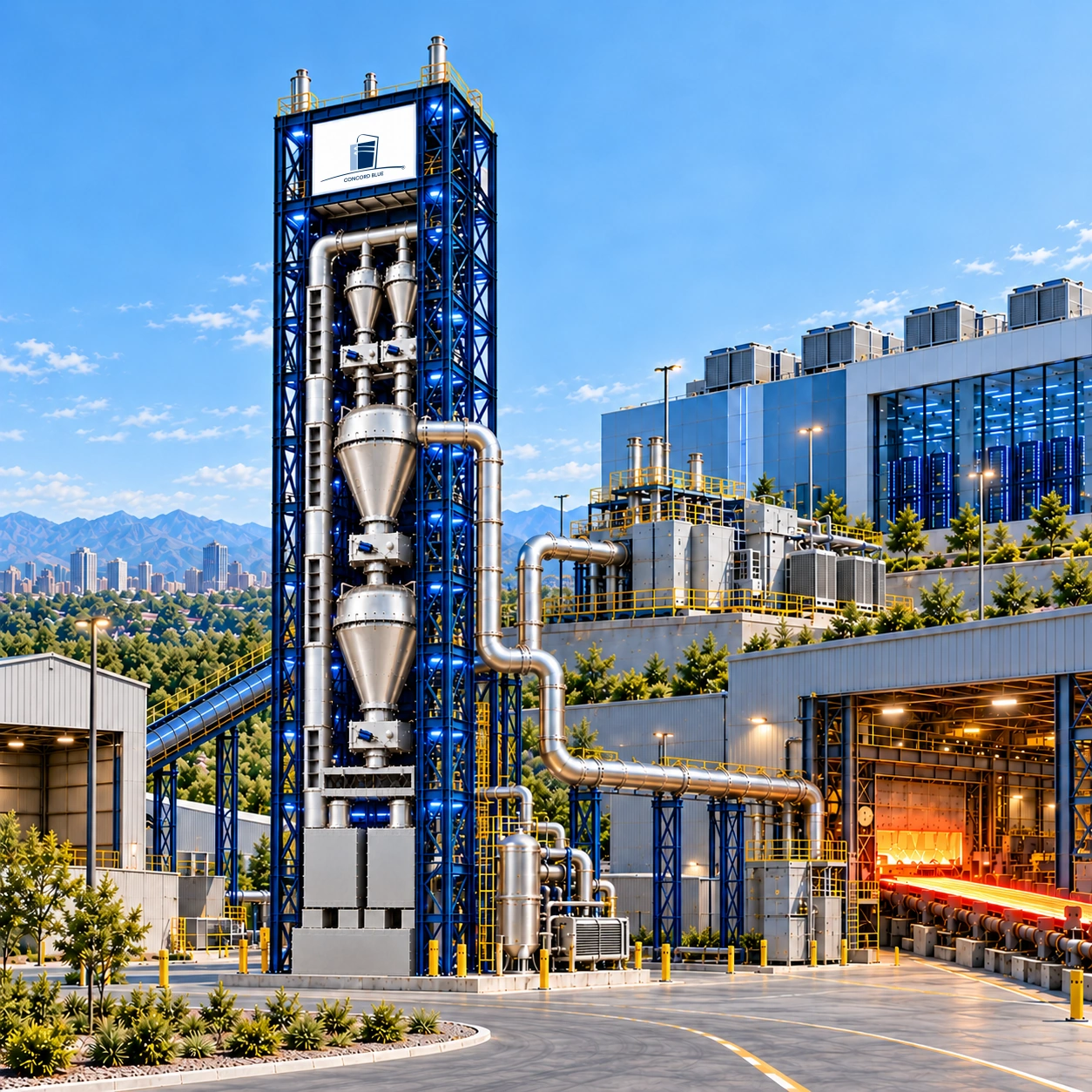
Convert local residual resources into hydrogen-rich syngas. The Concord Blue Reformer® combines steam thermolysis with staged reforming to create a flexible platform for industrial energy and fuels.
Explore the pathway ↓Prepared feedstock first undergoes thermal decomposition in the Thermolyzer. The resulting gas then passes through the Steam Reformer, where high-temperature steam reforming upgrades the gas phase. Circulating ceramic heat carriers supply heat indirectly, separating solid conversion from gas-phase reforming.
Accepted waste and biomass are prepared for the project. Steam thermolysis produces product gas and a solid residue.
The dedicated Steam Reformer transforms variable product gas into controlled, hydrogen-rich syngas. Ceramic media carry heat; they are not catalysts.
Gas treatment and conditioning meet the requirements of the selected power, industrial heat, hydrogen or fuel-production system.
Syngas, or synthesis gas, is a mixture principally containing hydrogen and carbon monoxide. Concord Blue’s staged reforming process produces hydrogen-rich syngas with a consistent composition and high calorific value. In the reference conditioned-gas case, its stoichiometric number is approximately 2.1, supporting its use as a feedstock for methanol synthesis.
Its spatially separated steam thermolysis and staged gas-phase reforming, with indirect heat supplied by circulating ceramic media. The second stage is central to upgrading the product gas.
Yes. Our syngas can displace natural gas in appropriately designed end uses and specific applications. Depending on its composition and the required conditioning or separation, syngas or a suitable gas fraction derived from it can also be blended into natural gas pipelines, provided it meets local gas-quality specifications, permitted blending limits and network-operator requirements.